|
|
|
|
|
 |
 |
 |
|
|
 |
|
|||
 |
 |
|
||
|
||||||||||||||||||
For further information, contactInstitute of Science, 1000 North 4th Street Phone 641-472-1200 |
The Congressional Prevention Coalition serves as a forum for education and discussion on the effectiveness and cost effectiveness of preventive approaches in health, social and economy policy. This new, active Coalition communicates to the Congress science-based information about prevention-related initiatives in social and economic policy and focuses on ways to integrate disease prevention and health promotion in our health care system. The Congressional Prevention Coalition on Stress Prevention: Its Impact on Health and Medical Savings, on June 24, 1998 was co-sponsored by Senators John Chafee and Bob Graham, and Representatives Jim Leach and Jim Moran and the Institute of Science, Technology and Public Policy. PRESENTATIONSModerator: John Hagelin, Ph.D., Director, Institute of Science, Technology and Public Policy Norman Anderson, Ph.D., Director of NIH's Office of Behavior and Social Science Robert Schneider, M.D. Director, Center for Health and Aging Studies, Principle Investigator on multiple NIH-funded grants: Stress Reduction in the Prevention and Treatment of Cardiovascular Disease Lee Lipsenthal, M.D. Medical Director, Preventive Medicine Research Institute (founded by Dr. Dean Ornish): Behavioral and Physiological Benefits of Stress Management in the Treatment of Coronary Artery Disease STRESS PREVENTION
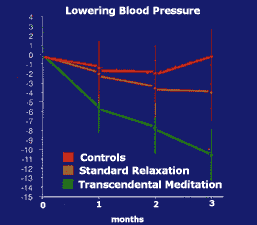
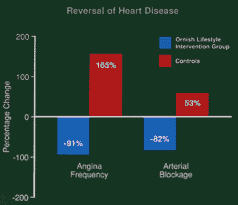
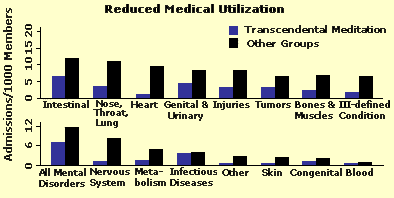
The NeedDespite rapid advances in modern medical science--and record high per capita medical expenditures--Americans endure some of the poorest health of any industrialized nation. But much of our nation's ill health is preventable. Leading medical experts estimate that 90% of disease is caused or complicated by stress. This epidemic of stress is a strong contributor to both high medical costs and poor medical outcomes. The ResearchWithin the past five years, scientific research has clearly demonstrated the effectiveness-- and cost-effectiveness-- of certain stress-reduction therapies in the prevention and treatment of disease. For example, heart disease, America's No. 1 killer, and its primary risk factor, hypertension, can be largely prevented--and even reversed--through simple, scientifically proven methods of stress reduction and lifestyle modification. The SavingsOver 50% of Medicare subscribers suffer from high blood pressure and 25% from more advanced stages of heart disease. These illnesses cost over $100 billion annually in largely preventable Medicare expenditures. Similarly, most other disease categories show dramatic improvements through use of stress reduction methods. These savings can be further leveraged by targeting high-risk patients and disease categories (like cardiovascular illness) that are particularly responsive to stress reduction methods. Effective stress prevention thus provides a scientifically proven means of improving national health and dramatically lowering health care costs.
|
|
|
|
|
 |
|
|
|
||
|
|
|
|
||
|
||